Know your diesel dependency
before the tank runs dry.
BTS towers in Africa, the Middle East and Southeast Asia face compound climate conditions and chronic diesel dependency. Velox gives every tower an hourly health score, tracks energy resilience in real time and alerts you to sandstorm, lightning and wind risk — before the outage, not after.
Where conventional data falls short.
The questions your network operations team
asks every day.
"How long can this tower run without intervention?"
ERS™ tracks energy coverage, battery autonomy and grid reliability in one score — updated every 4 hours. When resilience drops, your team knows immediately.
"How dependent on diesel is this tower right now?"
DFI™ flags critical diesel dependency before the tank runs dry. For operators in sub-Saharan Africa, this is the difference between proactive refuelling and emergency intervention.
"Is this tower operating within normal parameters?"
AHS™ aggregates climate exposure and infrastructure health into a 0–100 score. One recommended action tells your O&M team what to do — no interpretation needed.
"Is a sandstorm coming — and when should I shut down?"
GPS-classified arid and semi-arid zones only. PM10 + wind + humidity composite. Advance notice for cooling system protection and filter maintenance scheduling.
"What is the wildfire risk around this tower?"
WRI™ combines VPD, drought, wind and vegetation cover into a 0–100 risk score — with 7-day forecast. Operators see what is coming, not just what is happening now.
"How fast is this coastal tower degrading?"
Monthly cumulative corrosion score for coastal and industrial sites — humidity, salt, temperature cycling. Drive preventive maintenance before failure.
ERS 31 · Watch.
37.6L diesel/day. Grid reliability 35.
A BTS tower in Ethiopia. Energy coverage at 9%, battery autonomy 6 hours, grid reliability 35. DFI™ flags Critical Dependency at 85.3/100. The platform says: "Resilience at risk — verify battery charge level, check grid connection status. Increase monitoring frequency."
Your field team gets this alert automatically — before the tower goes dark.
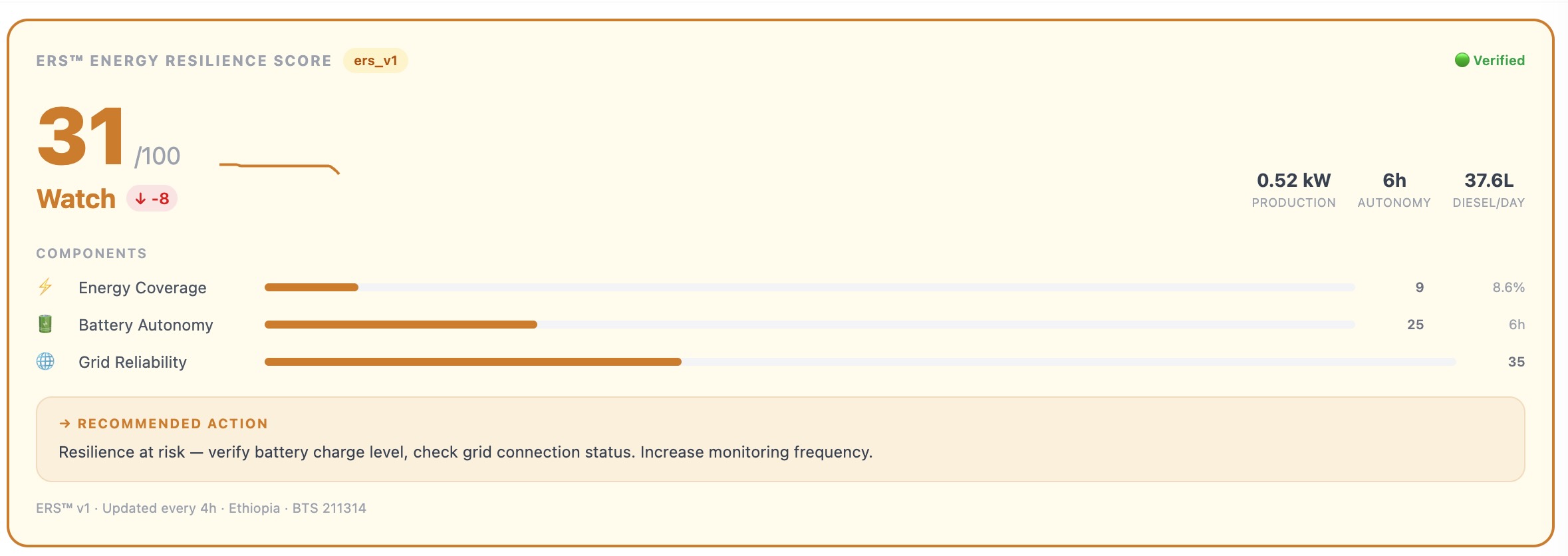
ERS™ + DFI™ · BTS 211314 · Ethiopia
The signals that matter for Telecom.
Sand storm events were our biggest unplanned maintenance cost in West Africa. Velox gave us 3-hour advance notice on 94% of events in the first quarter.
Start with the right tier.
Recommended for Telecom use cases. All plans include access to the full alert catalogue.